Can I Claim Damages If I Am Partially at Fault?
- August 10, 2026
The other driver blew through a stop sign and hit you, but now the insurance adjuster keeps asking why you were going five miles over the speed limit. If you're worried that sharing even a small piece of the blame wipes out your entire car accident claim, you are far from alone. It's one of the most common fears we hear from injured clients, and it's exactly the fear insurance companies count on.
The good news: South Carolina law does not work that way. You can still recover compensation even if you share some of the blame for what happened. The insurance company just does not want you to know that.
Below, our exceptional car accident attorneys explain exactly how South Carolina's fault rules work, how insurance adjusters try to use them against you, and what you can do to protect your claim.
South Carolina's Modified Comparative Negligence Rule
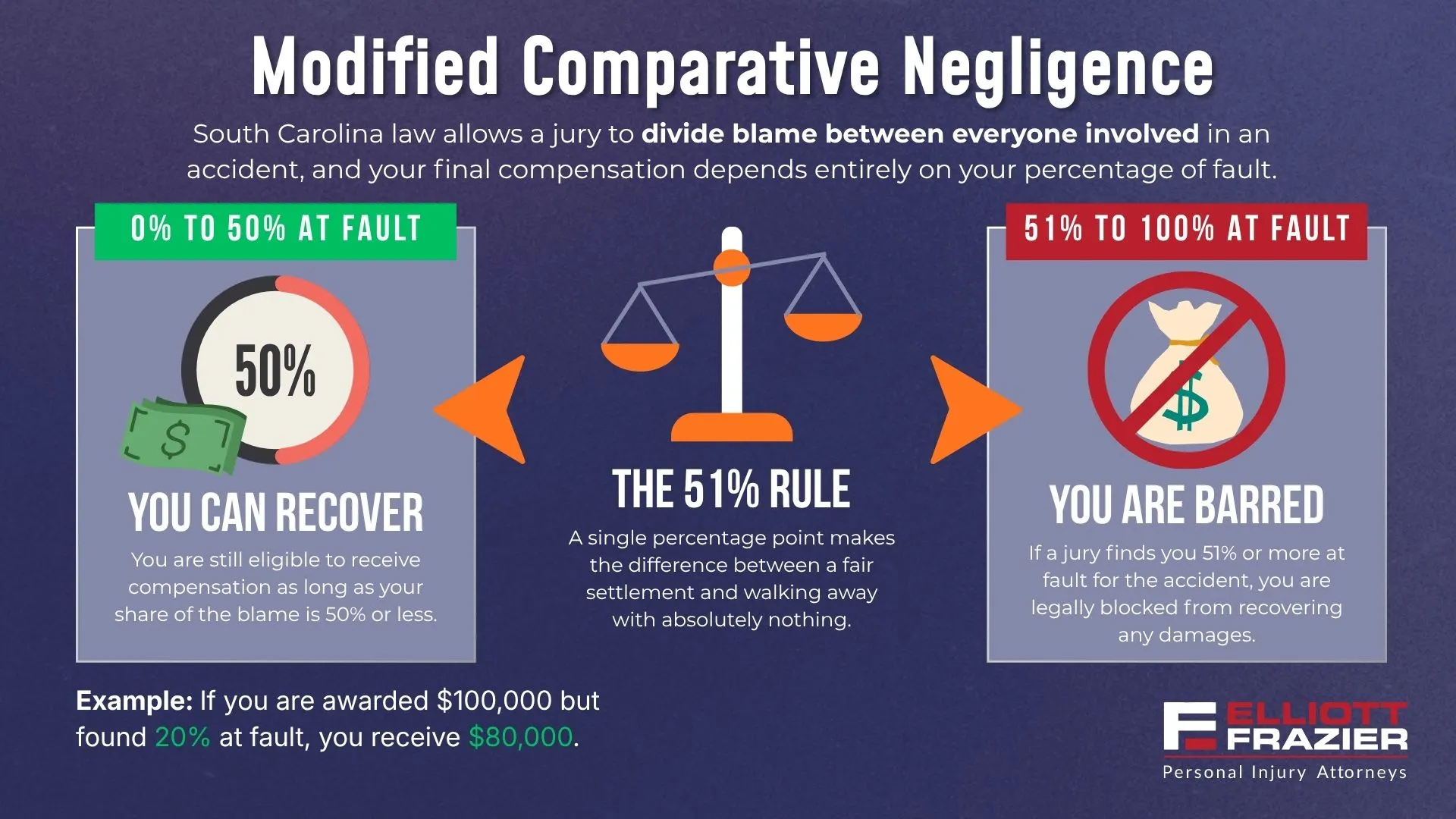
South Carolina follows what is known as modified comparative negligence. Instead of an all-or-nothing system, the law allows a jury to divide fault between everyone involved in an accident and adjust your compensation accordingly.
Here is how it actually works:
- You can still recover damages as long as you are found to be 50% or less at fault for the accident.
- Your total compensation is reduced by your percentage of fault.
- If a jury finds you 51% or more at fault, you are barred from recovering anything at all.
This is often called the 51% rule, and it means the difference between a fair settlement and walking away with nothing can come down to a single percentage point.
What This Looks Like in a Real Case
Say a jury awards you $200,000 for your injuries after a crash, but finds that you were 20% responsible because you were slightly speeding when the other driver ran a red light. Under South Carolina's rule, your compensation is reduced by that 20%, leaving you with $160,000.
Now imagine the insurance company convinces the jury that you were 55% at fault. Under the same rule, you recover nothing, regardless of how badly you were hurt or how reckless the other driver was. That single swing in the fault percentage is worth the entire case, which is exactly why insurance adjusters push so hard to shift blame onto you.
How Insurance Companies Try to Inflate Your Share of the Blame
Adjusters are trained to look for anything that lets them argue you contributed to your own injuries. Common tactics include:
- Twisting your own words: A recorded statement where you say "I didn't see them coming" can be spun into an admission that you weren't paying attention.
- Pointing to minor infractions: Going a few miles over the limit, a rolling stop, or not wearing a seatbelt can all be used to argue you share responsibility, even when they had nothing to do with causing the crash.
- Reconstructing the scene favorably: Adjusters will lean on partial photos, vague witness statements, or their own accident reconstruction to build a story that favors the driver they insure.
- Moving fast, before you have a lawyer: Insurers know that unrepresented victims are far more likely to accept a fault percentage they never should have agreed to.
#cta_start
Don't Let an Adjuster Assign You More Blame Than You Deserve
A single conversation with an insurance adjuster can shape your entire case before you even realize it. Let our team take over the conversation and protect what you're owed.
#cta_end
Protecting Yourself When Fault Is Disputed
Because a few percentage points can determine whether you recover anything, the evidence you gather matters immensely. Steps that help keep your fault percentage low and accurate include:
- Documenting the scene thoroughly: Photos of vehicle positions, skid marks, road conditions, and traffic signals help establish an objective record before it disappears.
- Identifying witnesses immediately: An unbiased account from someone with nothing to gain often carries more weight than either driver's version of events.
- Getting medical care right away: A clear record connecting your injuries to the accident makes it harder for an adjuster to argue your condition was unrelated or exaggerated.
- Avoiding recorded statements: Anything you say to the other driver's insurance company can be twisted, even when you are simply describing what happened. Learn more about what to do after a car accident to protect your claim from the very first moments.
Comparative Negligence Applies Beyond Car Accidents

The 51% rule is not limited to traffic collisions. It applies across South Carolina personal injury law, including:
- Pedestrian accidents: An insurer may argue you were jaywalking or crossing outside a crosswalk, as we cover in our guide on what to do if you were hit by a car as a pedestrian.
- Slip and fall claims: A property owner may claim you were distracted or ignored a warning sign, even when the hazard itself was never properly addressed.
- Multi-vehicle wrecks: When three or more drivers share blame, a jury divides fault among everyone involved, and your recovery depends on staying under the 51% threshold relative to the total fault.
Why Legal Representation Matters When Fault Is Shared
Comparative negligence disputes are won and lost on evidence and framing. An experienced attorney can:
- Investigate the crash independently rather than relying on the insurance company's version of events;
- Challenge inflated fault percentages with police reports, the use of accident reconstruction experts, and witness testimony;
- Negotiate from a position of strength instead of letting an adjuster define the narrative;
- Take the case to trial if the insurance company refuses to offer a fair number.
Dedicated Legal Support at Elliott Frazier Injury Law
Insurance companies know that comparative negligence disputes are one of the easiest ways to shrink or deny a payout, and they will use every tool available to shift blame onto you. At Elliott Frazier Injury Law, we proudly serve injury victims throughout Greenville and Upstate South Carolina. We know how adjusters build these arguments, and we know how to dismantle them.
If you were hurt in an accident and worry that shared fault might hurt your case, do not assume you are out of options. South Carolina law is more forgiving than most insurance companies want you to believe, and so are we. Contact us today for a free consultation to discuss your legal options and let our team start building your case.
Frequently Asked Questions (FAQs)
#faq_start
Can I still get compensation if I was partly responsible for the accident?
Yes. As long as a jury finds you 50% or less at fault, you can recover compensation, though the amount is reduced by your percentage of fault. You are only barred from recovering anything if you are found 51% or more responsible.
Who decides my percentage of fault?
If your case settles, the insurance companies and your attorney negotiate the fault percentage based on the available evidence. If the case goes to trial, a jury reviews the evidence and assigns a specific percentage of fault to each party involved.
Will the insurance company automatically try to blame me?
Often, yes. Assigning you even a small percentage of fault directly reduces what the insurance company has to pay, so adjusters are trained to look for any opportunity to shift blame, however minor.
Does being partially at fault affect how long I have to file a claim?
No. The standard South Carolina statute of limitations still generally gives you three years from the date of the accident to file a personal injury lawsuit against a private party, regardless of any shared fault. Waiting to gather evidence, however, only makes it easier for the other side to inflate your share of the blame.
#faq_end


.avif)
Angela Elliott Frazier
Angela Elliott Frazier protects and represents individuals facing personal injury challenges in South Carolina. She is committed to standing up for her clients' rights and guiding them through the legal process.
Worried You Share Some of the Blame?
Don’t let an insurance adjuster convince you that shared fault means you get nothing. Reach out to schedule your free consultation. We will review the facts and fight to protect the compensation you are owed.