Who Is Liable in a Truck Accident in South Carolina
- August 19, 2026
A truck accident is not like getting rear-ended at a stoplight. When an 18-wheeler slams into your regular-size car on I-85 or I-26, the damage is catastrophic, the financial stakes are enormous, and figuring out who is actually responsible is rarely straightforward. These cases often become very complex very quickly. Before you can pursue the compensation you deserve, you need to understand who is liable, and in a commercial truck accident, the answer almost always involves more than just the driver.
To help you protect your rights and your financial future, our skilled Greenville truck accident lawyers break down exactly how liability works in South Carolina commercial truck accident cases.
Truck Accident Liability in South Carolina
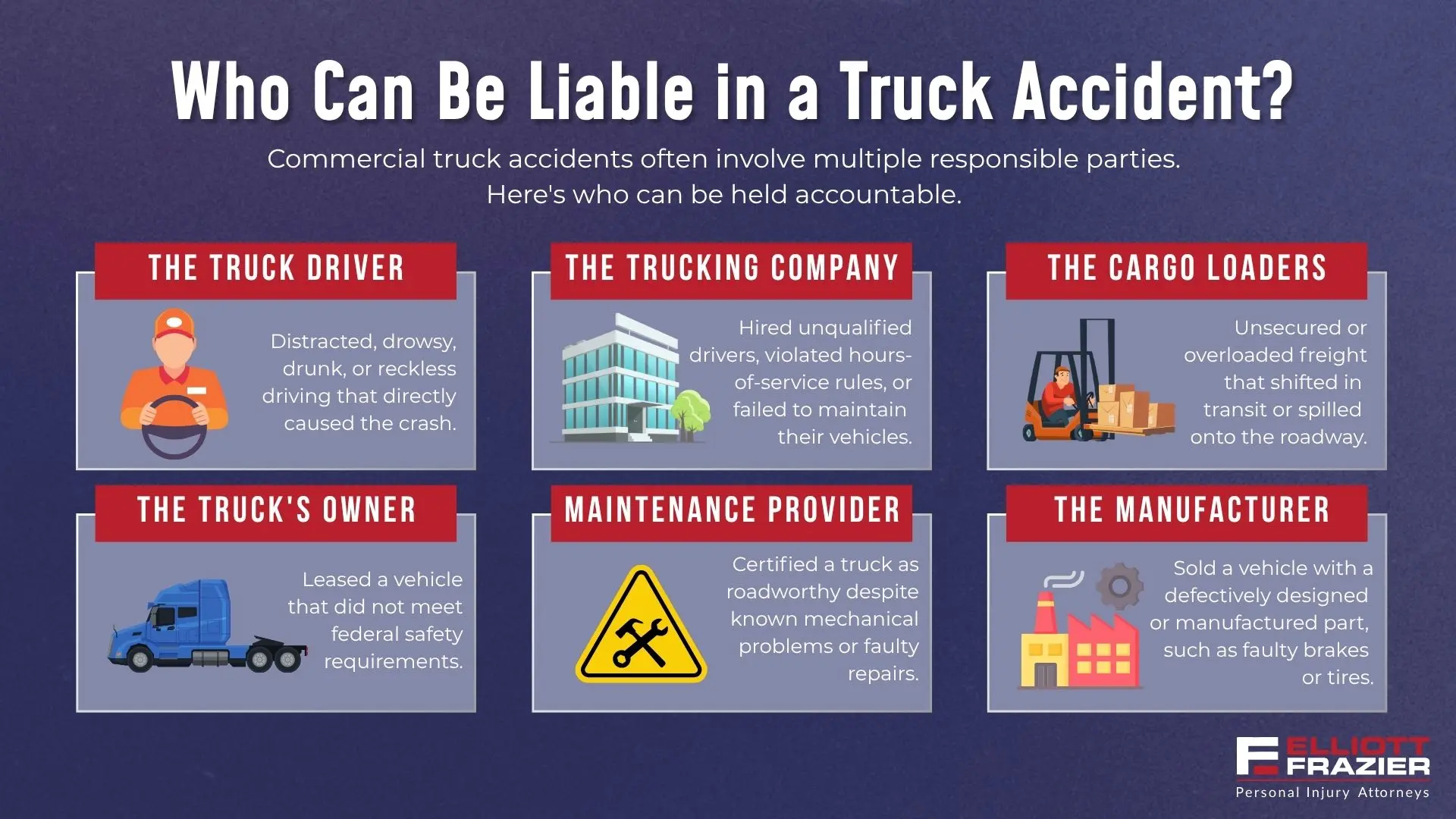
1. The Truck Driver
The most obvious potentially liable party is the driver behind the wheel. A truck driver can be held responsible for a crash caused by:
- Distracted driving: Texting, eating, or adjusting a GPS rather than watching the road;
- Drowsy driving: Pushing past federal hours-of-service limits and falling asleep while traveling at 75 mph down a highway;
- Drunk or impaired driving: Operating a commercial motor vehicle under the influence of alcohol or drugs;
- Speeding or reckless driving: Ignoring South Carolina traffic laws and the increased stopping distances that a fully loaded semi-truck requires;
- Failure to check blind spots: Wide-turn and sideswipe crashes are constant dangers when truck drivers neglect checking their mirrors.
If the driver was performing their normal job duties at the time of the crash, their employer may also be held responsible under the legal doctrine of vicarious liability, meaning the trucking company can be on the hook for the negligent actions of its employees.
2. The Trucking Company
A trucking company's liability does not begin and end with what their driver does on the road. A carrier can be held directly responsible when they:
- Hired unqualified drivers: Federal Motor Carrier Safety Administration (FMCSA) regulations require trucking companies to verify that drivers hold valid commercial driver's licenses, have clean driving records, and have received proper training. When a company fails to do that, they bear responsibility for what follows.
- Violated hours-of-service rules: The FMCSA sets strict limits on how long a driver can stay behind the wheel before a mandatory rest break. Companies that pressure drivers to exceed those limits are responsible for the predictable consequences.
- Failed to maintain their vehicles: Trucking companies must conduct regular safety inspections and maintain detailed maintenance records. Putting a truck with known mechanical problems on a South Carolina highway is negligence, plain and simple.
- Ignored or encouraged safety violations: Some carriers look the other way when drivers falsify logbooks or skip safety protocols. That deliberate disregard for safety regulations exposes the company to serious legal liability.
3. The Cargo Loaders
When unsecured cargo spills onto the interstate, it instantly becomes a deadly hazard for every vehicle in the area. A third-party cargo loading company can be held liable when:
- Freight is loaded beyond the truck's legal weight limit;
- Cargo is not properly secured, causing it to shift and destabilize the truck;
- Hazardous materials are handled or labeled improperly.
Cargo loaders are often a separate business from the trucking company itself, which is why identifying every party involved is a critical step in building your truck accident case.
4. The Truck's Owner
The driver and the trucking company are not always the same entity. In many commercial truck accident cases, the driver is an independent contractor operating a vehicle leased from a separate owner. When the truck's owner failed to ensure the vehicle met federal safety requirements before putting it on the road, they can be held responsible for your injuries and damages, along with the driver and the carrier.
5. Maintenance Providers
Many trucking companies outsource their vehicle upkeep to third-party mechanics. A maintenance company can be held liable for a crash when they:
- Certified a truck as roadworthy despite known mechanical problems;
- Missed worn brake pads, defective tires, or faulty steering components during an inspection;
- Used improper parts or performed substandard repairs that directly contributed to the wreck.
6. The Truck Manufacturer
Sometimes the crash is not caused by human error at all, but the direct result of a defective truck part. If a component such as the braking system, tires, or steering mechanism was defectively designed or manufactured, you may have a product liability claim against the manufacturer. This can run alongside any personal injury claims against the driver or the trucking company, and identifying a defective part early requires immediate preservation of evidence.
#cta_start
Not Sure Who Is Responsible for Your Crash?
We investigate every angle and identify every party that owes you compensation. Reach out today for a free consultation.
#cta_end
Why Truck Accident Liability Is More Complex Than a Crash Between Two Cars
In a standard car accident, you typically deal with one at-fault driver and one insurance company. Commercial truck accident cases often involve multiple defendants, each with their own insurance policy, each with their own team of adjusters, investigators, and lawyers, and each working hard to minimize their share of the blame and their share of the money you’re owed.
Federal regulations add another layer of complexity. Commercial motor vehicles are governed by strict safety rules set by the FMCSA. These regulations cover everything from how many consecutive hours a driver can stay behind the wheel to how cargo must be secured. When a trucking company or driver violates these federal requirements, it becomes powerful evidence of negligence.
How South Carolina's Comparative Negligence Rule Affects Your Claim
South Carolina follows a modified comparative negligence rule, meaning you can still recover compensation even if you were partially at fault for the crash, as long as your share of the blame is 50 percent or less. Your final settlement is reduced by your assigned percentage of fault.
Insurance adjusters for trucking companies routinely try to shift blame onto the victim to reduce their payout. They will scrutinize your speed, your lane position, and your actions in the seconds before impact. Our skilled truck accident attorneys know how to counter these tactics and protect your right to fair compensation.
How Is Liability Established After a Truck Accident
Determining liability (who was at fault) in a commercial truck accident requires far more than a police report. Because multiple defendants and multiple insurance policies are often in play, building a strong case demands a thorough investigation. Our legal team moves quickly to:
- Secure the truck's black box (ECM): The electronic control module records speed, braking force, and steering inputs in the moments before impact. This crucial evidence can directly prove driver error or mechanical failure, and trucking companies know it.
- Subpoena driver logbooks and ELD data: Electronic logging device records reveal whether the driver violated federal hours-of-service limits and drove while dangerously fatigued.
- Pull maintenance and inspection records: These records show whether the trucking company neglected vehicle maintenance before putting that truck on the road.
- Review hiring and training records: If the company placed an unqualified driver on a South Carolina highway, those records will prove it.
- Gather witness statements and camera footage: Eyewitness accounts and video evidence lock in the facts before memories fade and footage gets overwritten.
Time is not on your side. Trucking companies send rapid-response teams to crash scenes immediately, and their sole job is to protect corporate interests. The sooner you have legal representation, the sooner we can preserve the evidence that matters.
What Damages Can You Pursue After a Commercial Truck Accident
When multiple parties are responsible for your crash, you have the right to pursue compensation from each. We fight to recover every dollar you have lost.
- Monetary damages cover your hard out-of-pocket costs: emergency room bills and future medical expenses, lost wages and lost income from missed work, loss of earning capacity if your injuries are permanent, costs to repair or replace your vehicle, and home modifications required for a long-term disability.
- Nonmonetary damages compensate you for the personal toll the crash has taken on your life, including physical pain and daily suffering, emotional trauma and post-traumatic stress, loss of independence and mobility, and loss of consortium, which is the impact your injuries had on your spouse and your family.
- Punitive damages may also be available when a truck driver or trucking company acted with outrageous disregard for human life, such as knowingly sending a driver out in a truck with failing brakes or deliberately falsifying safety records. South Carolina law allows the court to award these to punish that behavior.
Team Up with an Experienced Greenville Truck Accident Lawyer Today
Being seriously injured by an 18-wheeler is a traumatic, life-altering event. The path to recovery is long, and you should not have to fight a team of corporate lawyers while you are focusing on your health and your family. We’ll take on the fight for you.
At Elliott Frazier Injury Law, we take truck accident cases personally. Our founder, Angela Frazier, built this firm on a deeply personal foundation: a landmark South Carolina Supreme Court victory won by her family against a negligent corporation that chose profits over the life of her grandfather. That legacy drives every commercial truck accident case we take on. Angela holds a Master of Business Administration (MBA), which gives our team a distinct advantage when calculating the full, lifelong economic impact of your injuries.
We work alongside life care planners and economic experts to ensure that no future medical expenses you’ll face go unaccounted for before we sit down at the negotiating table. We handle the heavy lifting, from securing black box data and subpoenaing corporate records to aggressively negotiating with adjusters and taking the case to trial if the trucking company refuses to do right by you.
Contact us today for a free, confidential consultation. Our dedicated truck accident attorneys serve Greenville, Spartanburg, Anderson, Greenwood, Oconee, Pickens, and Laurens counties.
FAQs
#faq_start
Can more than one party be liable in a truck accident in South Carolina?
Yes, and in most commercial truck accident cases, multiple parties share responsibility. The driver, the trucking company, the cargo loaders, and the maintenance provider can all be held liable at the same time, depending on what the investigation uncovers. This is one of the most important reasons to have an attorney investigate the case rather than accepting a quick settlement from a single insurer.
How long do I have to file a truck accident lawsuit in South Carolina?
South Carolina's statute of limitations gives you 3 years from the date of the crash to file a personal injury lawsuit. If the crash resulted in a wrongful death, the family also has 3 years from the date of death to take legal action. However, the evidence that wins truck accident cases (black box data, driver logs, maintenance records, witness accounts) can disappear quickly. Do not wait to reach out to us for a free consultation. Every day you wait to call us, your case gets harder to win.
What if the trucking company says their driver was an independent contractor?
This is a common tactic carriers use to dodge liability. Even when a driver is classified as an independent contractor and technically works for themselves, the trucking company may still be held responsible if it exercised significant control over the driver's work, provided the truck, or if the driver was carrying out work they were hired to perform. Our legal team knows how to cut through these corporate structures to hold the right parties accountable.
Should I talk to the trucking company's insurance adjuster?
No. You should never provide a recorded statement to the trucking company's insurance adjuster without legal representation. These adjusters are trained to ask questions that extract information they can take out of context and use to minimize your claim or shift blame onto you. Tell them to contact your attorney and call us immediately.
What if I was partially at fault for the truck accident?
South Carolina's modified comparative negligence rule means you can still recover compensation as long as you were 50 percent or less at fault for the crash. Your total damages are simply reduced by your assigned percentage of fault. Insurance adjusters routinely try to inflate your share of the blame to reduce what they owe. Our experienced attorneys know how to push back on these tactics and protect your right to a fair recovery.
#faq_end


.avif)
Angela Elliott Frazier
Angela Elliott Frazier protects and represents individuals facing personal injury challenges in South Carolina. She is committed to standing up for her clients' rights and guiding them through the legal process.
Not Sure Where to Start? Start with a Quick Call.
Let our experienced truck accident attorneys review your case, identify every liable party, and fight to secure the compensation you are owed. We’ll give you honest answers to your questions.